TL;DR: Mexico tariffs on Chinese machinery are back in the news: on 23 November 2026 China and Mexico held high-level trade talks in Beijing and, as China’s commerce ministry said on 26 November, agreed to set up a working group on tariff reduction. No new rates or dates have been announced, so the duties in force since 1 January 2026 still apply. Before you order, check each product’s Mexican tariff line, price the duty into your landed cost and write a tariff-change clause into the contract.
For Mexican importers, dealers, rental companies and project buyers sourcing equipment and parts from China. Reviewed 27 November 2026. Since Mexico’s tariff reform took effect, Mexico tariffs on Chinese machinery have depended on one detail: the exact tariff line (fracción arancelaria) of each item. Here is what changed this week, how the 2026 decree works and a checklist for your next China order. It is general commercial guidance, not legal or customs advice.
What happened between China and Mexico this week?
- 23 November 2026, Beijing. Chinese Commerce Minister Wang Wentao and Mexican Economy Secretary Marcelo Ebrard co-chaired the 11th meeting of the China–Mexico High-Level Working Group. China urged Mexico to address its concerns over tariffs on Chinese goods and to use trade remedies prudently; Ebrard said Mexico is willing to strengthen institutionalised dialogue on tariffs (MOFCOM, 24 November 2026).
- 26 November 2026. MOFCOM spokesperson He Yadong said the two sides agreed to set up a working group to hold dialogue on tariff reduction (Xinhua via gov.cn, 26 November 2026).
- The trade gap behind it. According to EFE, Ebrard estimated that Chinese sales to Mexico will exceed US$130 billion this year, against roughly US$10 billion of Mexican sales to China (El Financiero, 26 November 2026).
A working group is a process, not a tariff cut: nothing published names products, rates or a timetable.
How do Mexico tariffs on Chinese machinery work in 2026?
The key facts of the reform, from the decree and two professional summaries:
| Point | What it says | Source |
|---|---|---|
| Legal basis | Decree amending tariff lines of Mexico’s import tariff schedule (LIGIE), published in the Diario Oficial on 29 December 2025 | EY México |
| In force | 1 January 2026, with no general transitional provisions | EY México |
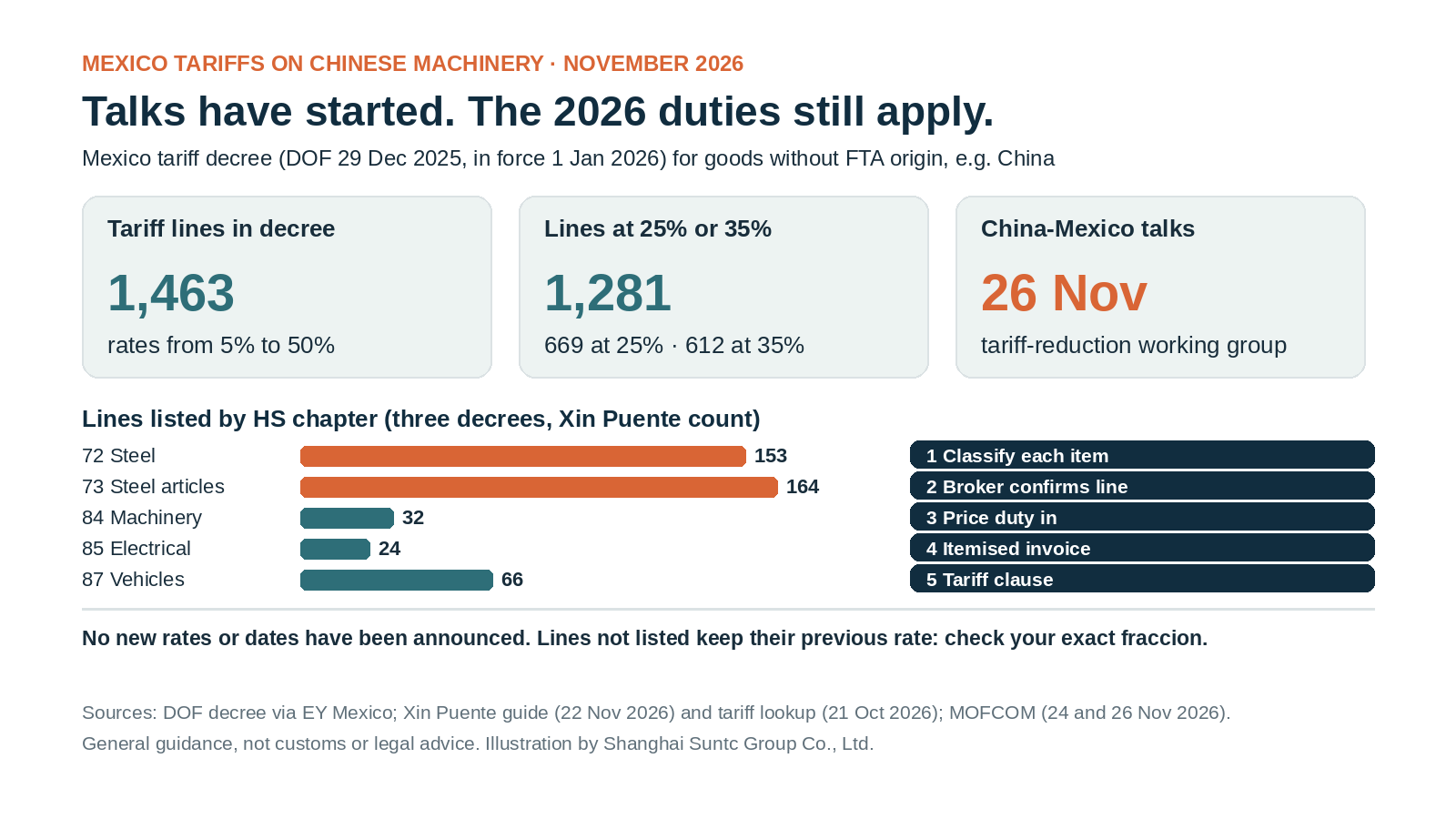
| Scope | 1,463 tariff lines; rates from 5% to 50%; 669 lines at 25% and 612 at 35% | Xin Puente, 22 November 2026 (count of the decree text) |
| Who pays | Imports that do not qualify under a Mexican free trade agreement. China has no FTA with Mexico, so Chinese-origin goods on listed lines pay the new rate | EY México; Xin Puente |
| Relief that still exists | PROSEC sector programmes and Rule Eight continue, but only within their scope (authorised manufacturers, covered goods, valid permits) | EY México |
| Later changes | The schedule was amended again on 23 April and 13 October 2026; lines not listed keep their previous rate | Xin Puente tariff lookup, updated 21 October 2026 |
Which China machinery purchases are most exposed?
Most of the listed lines are not machines. Xin Puente’s chapter count of the three decrees shows where they sit:
| HS chapter | What it covers | Lines listed | Why a machinery buyer should care |
|---|---|---|---|
| 72 | Iron and steel | 153 | Steel plate or bar bought for local fabrication |
| 73 | Articles of iron or steel | 164 | Structures, fasteners and fabricated parts shipped with a machine |
| 84 | Machinery and mechanical appliances | 32 | Check your machine and its parts line by line |
| 85 | Electrical machinery and equipment | 24 | Motors, generators, cables and control panels |
| 87 | Vehicles and parts | 66 | Trucks, trailers and vehicle parts in a project package |
A complete machine may sit on a line the decree did not touch while the steel parts, trailer or cables in the same shipment do not. Only the exact eight-digit Mexican line tells you: the first six HS digits are shared, but the last digits of a Chinese export code do not match Mexico’s.
Checklist: what to do before you sign a China order for Mexico
- Classify every item, not just the machine. Ask the supplier for a line-by-line packing list with HS codes, then have your licensed customs broker (agente aduanal) confirm the Mexican fracción. You can check current rates on Mexico’s SNICE tariff information.
- Price the duty into landed cost. The import duty is a percentage of customs value; IVA and the DTA fee are separate. Compare suppliers on the same Incoterm.
- Split invoices honestly. If machine, attachments and spare parts fall under different lines, show them as separate invoice lines with real values. Never undervalue or mis-describe goods to reach a lower rate.
- Do not rely on rerouting. Preferences depend on where goods are made under the relevant agreement’s rules of origin, not on the port they ship from. Global Times, citing Reuters on 11 November, reported that Mexico is working to stop steel from China and other countries being rerouted through Mexico into the US (Global Times, 24 November 2026).
- Ask about programmes early. If you are a manufacturer, ask your broker whether PROSEC, Rule Eight or an IMMEX temporary-import structure fits your case. These are targeted tools with conditions, not general exemptions.
- Write a tariff-change clause. Agree who bears a rate change between contract and import, under which Incoterm. Our purchase order tariff clause guide explains the options.
Should you wait for the China–Mexico tariff talks?
Usually not, if you need the equipment for a season or project. The working group has no published timeline, and any outcome needs a formal change to Mexico’s tariff schedule before it applies at the border. Order on today’s rates with a clear tariff clause and watch the Diario Oficial for amendments.
Hypothetical example: a dealer importing a machine with steel attachments
A Mexican dealer plans to import one machine from China plus a set of steel attachments and a box of spare parts. The dealer asks for a three-line invoice with HS codes; the broker finds that the machine’s line is unchanged while one parts line is on the decree list. The dealer prices the duty into landed cost, keeps the order and adds a clause sharing any rate change before import. This example is illustrative and does not describe a real customer, product or rate.
SUNTC view: classify first, then negotiate
Tariff talks make headlines, but the duty on your shipment is decided line by line. Get codes, values and contract terms right before ordering, whatever the working group decides.
Shanghai Suntc Group Co., Ltd. is an international trade and export company in Shanghai Free Trade Zone, not a manufacturer and not a customs broker. We can discuss construction machinery including wheeled excavators and material handlers, agricultural machinery and hydropower equipment, and prepare a clear quotation with itemised lines, HS code references from the supplier and shipping documents your broker can check. See how we work. Manufacturer, configuration, pricing and contracting responsibilities are confirmed in each specific quotation. Contact Jack Chen at info@suntc.com or WhatsApp +86 150 0214 3331, visit our contact page, or send your requirements below.
Sources
MOFCOM (24 Nov 2026); Xinhua via gov.cn (26 Nov 2026); El Financiero/EFE (26 Nov 2026); Global Times (24 Nov 2026); EY México tax flash (Jan 2026); Xin Puente guide (22 Nov 2026) and tariff lookup (21 Oct 2026). All linked above.
Buyer questions
Has Mexico cut tariffs on Chinese machinery?
No. On 26 November 2026 China’s commerce ministry said the two countries agreed to set up a working group on tariff reduction, but no products, rates or dates have been announced. The rates in force since 1 January 2026 still apply.
Does Mexico’s 2026 tariff increase cover all machinery from China?
No. The decree lists 1,463 specific tariff lines, mostly textiles, apparel, steel and other goods; only 32 lines in chapter 84 and 24 in chapter 85 appear in the decrees counted by Xin Puente. Lines not listed keep their previous rate, so check your exact eight-digit fracción with a customs broker.
Can I avoid the duty by shipping through another country?
No. Trade-agreement preferences depend on where goods are made under the rules of origin, not the shipping route. Misdeclaring origin or value is a compliance risk; use legal tools such as PROSEC or Rule Eight only if you qualify.
What documents should I ask a Chinese supplier for?
An itemised invoice and packing list with real values and HS codes per item, technical data to support classification, and the bill of lading. Your Mexican customs broker confirms the final classification.
Can SUNTC help with an order for Mexico?
Yes, as a trade and export company, not a manufacturer or customs broker. SUNTC Group can prepare an itemised quotation and shipping documents for your broker to review. Manufacturer and contract responsibilities are confirmed in each quotation.