TL;DR: A China purchase order tariff clause decides who pays if a new import duty lands between your order and customs entry. With the US Trade Representative saying on 20 November 2026 that the Section 301 “overcapacity” probes into 16 economies, China included, will be completed by year-end, and the US–China truce measures running only to 9–10 January 2027, any order that will be entered in 2027 should state the Incoterm, the importer of record, the price validity and what happens to the price if duties change.
For importers, distributors, e-commerce sellers and project buyers placing orders in China for delivery in 2027. Reviewed 24 November 2026. Tariff news moves faster than production. A machine or product line ordered in late November is often built in December, shipped around Chinese New Year and entered at destination in January or February. This practical guide shows how to write a China purchase order tariff clause that both sides can live with, which documents to fix in advance, and how to compare offers when the duty rate is uncertain. This is general commercial guidance, not legal advice.
Why does a tariff clause matter for China orders right now?
Three dated developments put 2027 landed costs into question for orders placed now:
- Overcapacity probes with a year-end target. In a Bloomberg Television interview on 20 November 2026, USTR Jamieson Greer said the Section 301 investigations “will certainly be completed by the end of this year”, without naming countries or rates, as reported by Financial News (21 November 2026). USTR’s March 2026 fact sheet lists the 16 economies (including China, the EU, Japan, Korea, Vietnam, Mexico and India) and an illustrative list of sectors that includes machinery, machine tools, batteries, electronics, steel and transportation equipment.
- Short truce windows. The Federal Register notice of 10 November 2026 extends the 178 remaining Section 301 product exclusions only through 9 January 2027. On China’s side, the Customs Tariff Commission announcement of 9 November 2026 keeps the 24% additional tariff on US goods suspended for two months from 10 November, with 10% retained.
- Duties already stacked, and still in court. USTR’s July 2026 fact sheet set 10% or 12.5% forced-labour Section 301 tariffs on 60 trading partners, with articles subject to Section 232 tariffs not covered. Capital Times (3 November 2026) reported China at 12.5% and the Court of International Trade challenge still undecided, and the ICPA Section 301 tracker (updated 16 November 2026) notes the duties remain payable while the case runs.
None of this tells you what the January rate will be. It does tell you that a price agreed today may meet a different duty at entry, so the purchase order should say who carries that change.
Who pays a new tariff: FOB, CIF or DDP?
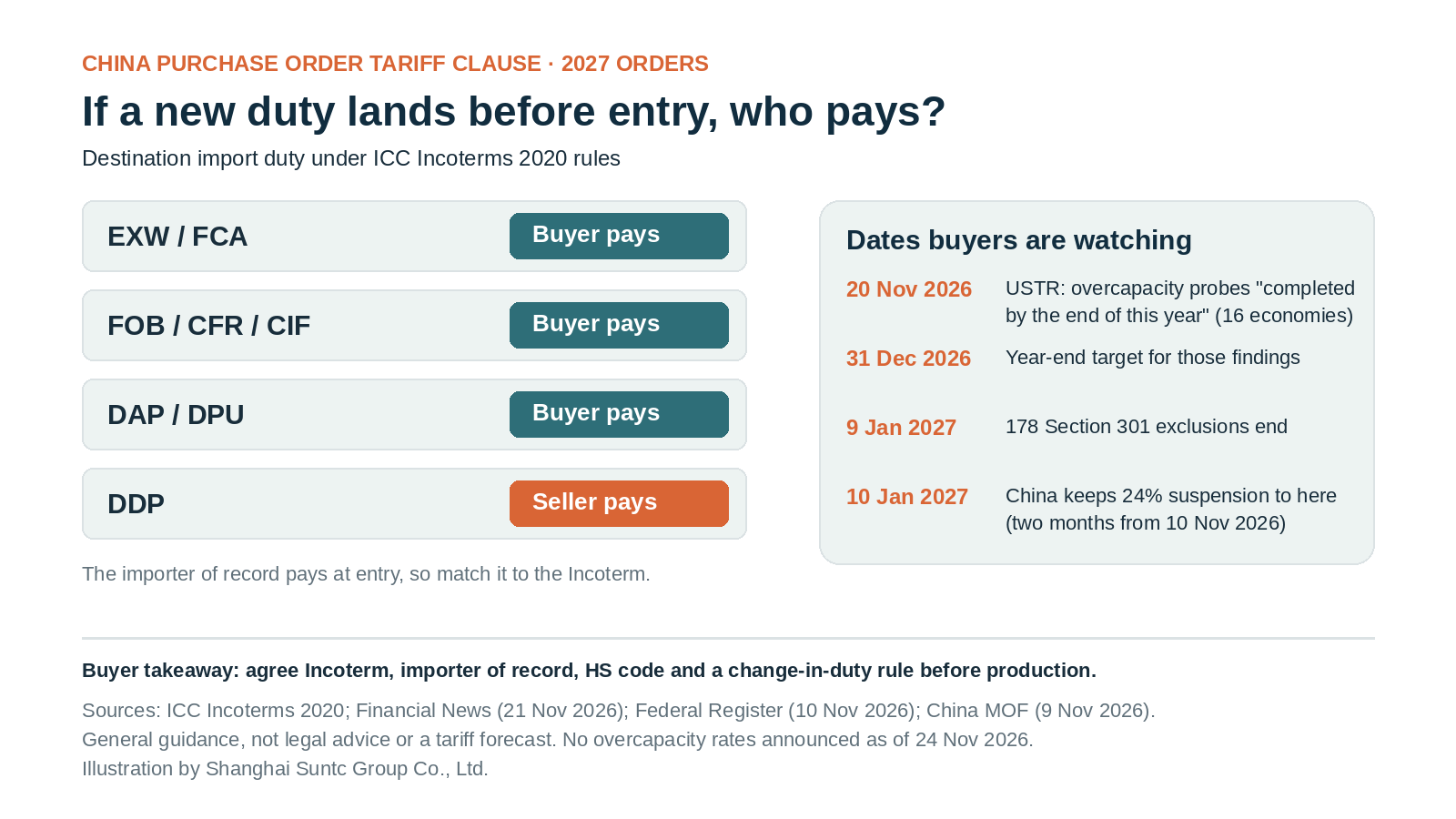
Under the ICC Incoterms® 2020 rules, import duties and import clearance fall on the buyer under every rule except DDP, where the seller takes them on. In practice the party that pays is the importer of record, so the Incoterm and the importer of record must match.
| Incoterm on your order | Who normally pays destination duty | What to add to the tariff clause |
|---|---|---|
| EXW / FCA | Buyer | Correct HS code and origin from the supplier; buyer’s right to delay pickup if duty changes |
| FOB / CFR / CIF | Buyer | Fixed product price; agreed shipment window; who pays storage if the buyer holds cargo |
| DAP / DPU | Buyer | Same as above, plus how a delay at destination affects delivery dates |
| DDP | Seller (as importer of record) | Explicit “change in duty” rule: pass-through, cap, shared or right to cancel unshipped goods |
Watch for a DDP quote from a seller that cannot act as importer of record in your country, or one that silently assumes today’s duty rate. Ask which rate is built in and what happens if it changes.
What should a China purchase order tariff clause say?
A workable clause is short and specific. Agree these points with your supplier (and, for larger contracts, your lawyer or customs broker):
- Trigger. Define the event: a new or increased duty, or the end of an exclusion, that applies to goods entered after a stated date.
- Price basis. State that the product price is ex-duty and name the Incoterm (for example FOB Shanghai or CIF destination port).
- Allocation. Choose one: buyer bears all duty changes; seller absorbs up to an agreed percentage; costs shared; or either side may cancel or re-time goods not yet shipped.
- Cut-off by shipment, not order date. Duties usually follow the date goods are entered for consumption, not the order date, so tie options to ex-factory and on-board dates.
- Origin and classification. The supplier confirms the country of origin, HS code and description in writing before production; changing either later can change the duty.
- Price validity. Give the quotation a clear validity date and a re-quote rule for raw-material or exchange-rate changes, separate from duties.
- Records. Keep the commercial invoice, packing list, bill of lading and entry summary together; if a court ruling ever leads to refunds, entry records matter.
Should you ship before January 2027?
Pulling cargo forward can protect a known duty rate, but it is not free. Before you ask a Chinese factory to accelerate, check three things:
- Entry date versus sailing date. A shipment that sails in December but is entered in January may still meet the January rate. Work back from the expected entry date.
- Factory capacity before the holiday. Chinese New Year 2027 falls in early February; see our CNY 2027 order timeline for the shutdown and restart window.
- Freight and storage costs. Rushed bookings and early arrival can add costs that outweigh the duty you avoid; our freight booking guide covers how to compare lanes.
How do you compare Chinese quotations when duties are uncertain?
Rank offers on product price first, using the same Incoterm, currency and validity, then model landed cost under two or three duty scenarios that your broker confirms. Do not let a lower DDP price hide a duty assumption. Our guide on how to compare equipment quotations shows how to line up inclusions, and the equipment import checklist lists the documents your broker will ask for.
A hypothetical example
A US equipment distributor orders wheeled excavators from China on FOB Shanghai terms for entry in late January 2027. The purchase order fixes the machine price and HS code, makes the distributor importer of record, and adds a clause: if a new US duty above an agreed threshold applies before the goods are shipped, either side may push the shipment back by up to 60 days or cancel unshipped units without penalty; deposits for cancelled units are refunded or credited. This example is illustrative and does not describe a real customer or transaction.
SUNTC view: put the duty question on paper
Tariff decisions may come at short notice. Buyers who agree the Incoterm, importer of record, classification and a simple change-in-duty rule before production will spend less time renegotiating when the next notice appears.
Shanghai Suntc Group Co., Ltd. is an international trade and export company in Shanghai Free Trade Zone, not a manufacturer. We can discuss construction machinery, material handlers, agricultural machinery and hydropower equipment, and help you set out Incoterms, documents and shipment timing in a clear quotation. Manufacturer, configuration, pricing and contracting responsibilities are confirmed in each specific quotation. Contact Jack Chen at info@suntc.com or WhatsApp +86 150 0214 3331, visit our contact page, or send your requirements below.
Buyer questions
Who pays US tariffs on goods bought from China on FOB terms?
Under FOB and every Incoterms 2020 rule except DDP, import duties are the buyer’s responsibility, paid by the importer of record at entry. A tariff clause can still share or limit that cost by agreement.
When will the Section 301 overcapacity tariffs be decided?
USTR Jamieson Greer said on 20 November 2026 that the investigations into 16 economies will be completed by the end of 2026. He did not name countries or rates, so buyers should not assume a specific January duty.
Can a Chinese supplier guarantee a duty-paid price for 2027?
Only under DDP terms and only if the supplier can act as importer of record in your country. Ask which duty rate is included and what the contract says if that rate changes before entry.
Does the order date or the entry date decide which tariff applies?
In the US, duty rates generally follow the date goods are entered for consumption, as the 10 November 2026 exclusion notice shows. Ordering or shipping earlier does not by itself lock in a rate; confirm timing with your customs broker.