TL;DR: A China factory audit checks whether a supplier can build every unit to the specification it quoted, not just the sample it showed you. This week China’s market regulator summoned 15 e-bike makers after unannounced certification inspections found weak “product consistency” controls, a reminder that certificates alone do not prove consistent production. Before you pay a deposit, verify the legal entity, the real production site, the quality records and the test bench, and write the audit findings into the purchase order.
For importers, dealers, distributors and project buyers sourcing machinery and equipment from China. Reviewed 28 November 2026. Most quality problems on a machinery order are decided before production starts: who builds the machine, which components go in, and whether anyone checks them. A China factory audit before you sign is the cheapest way to find out. Below: the latest regulatory news, what a machinery factory audit covers, and a checklist for you or a third-party auditor. It is general guidance, not legal advice.
What did China’s regulators find this week?
Two official releases from the past few days show why buyers should look past certificates:
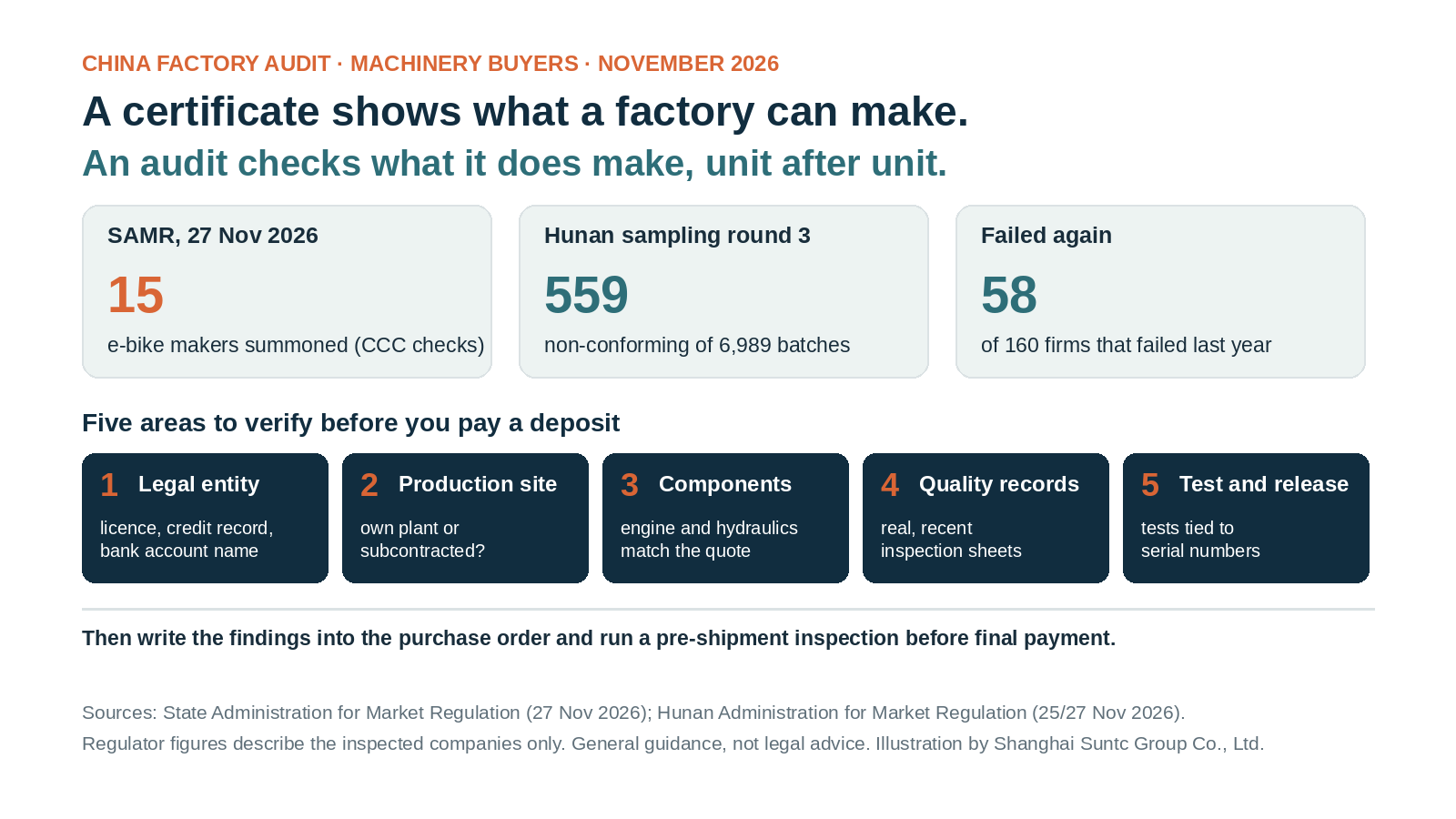
- National: CCC inspections of e-bike makers. On 27 November 2026 the State Administration for Market Regulation (SAMR) summoned 15 electric bicycle companies, including Yadea, Aima and Ninebot. SAMR said full-coverage unannounced inspections under China Compulsory Certification (CCC) found weak quality assurance capability and loose product consistency controls, and that some companies had shipped products that did not meet mandatory national standards. Defective products must be recalled (China Daily, 27 November 2026; Xinhua via People’s Daily, 27 November 2026).
- Provincial: Hunan quality sampling. The Hunan Administration for Market Regulation published its third 2026 provincial sampling round on 27 November (notice dated 25 November). It covered 6,989 batches from 4,046 businesses and found 559 non-conforming batches, including 4 batches of hydraulic parts, 6 of low-voltage switchgear, 12 of wires and cables and 2 of general equipment. Of 160 companies that failed the previous year’s sampling, 58 failed again.
E-bikes are not excavators, and these results describe the inspected companies only. The lesson for machinery buyers is general: a certificate or an approved sample shows what a factory can make; an audit checks whether it controls what it does make, batch after batch.
Demand adds pressure. At a 16 November news conference, the National Bureau of Statistics said export delivery value of equipment manufacturers above designated size rose 12.5% year on year in January–October 2026, the fastest for the period in five years (China Daily, 26 November 2026). Busy lines can mean more subcontracting, so confirm where your unit will be built. See our China machinery lead time guide for the scheduling side.
What should a China factory audit for machinery cover?
A machinery audit is narrower and more practical than a full ISO certification audit. Focus on the five areas below:
| Audit area | What to check | Evidence to ask for |
|---|---|---|
| 1. Legal entity | The company on the contract exists, is active and its business scope covers what it sells | Business licence; record on the official National Enterprise Credit Information Publicity System; bank account in the same name |
| 2. Production site | Where your model is welded, machined, assembled and painted; what is outsourced | Site address, process flow, list of key subcontractors (structures, hydraulics, cabs) |
| 3. Components | Engine, pumps, valves, cylinders and electrics match the quoted brands and models | Bill of materials with brands; incoming inspection records; supplier certificates |
| 4. Quality records | Inspection is done and recorded, not just written in a manual | Recent in-process and final inspection sheets; non-conformity log; calibration labels on gauges |
| 5. Test and release | Each unit is tested before it leaves, with results tied to its serial number | Test bench or test area; test reports for recent units; serial-number traceability |
China factory audit checklist: what to do on site
Use it yourself or hand it to a third-party inspection company.
- Match names. The company name on the business licence, the proforma invoice and the bank account should match. If not, ask why before paying. Our bank account change guide explains what to do if details change later.
- Ask “factory or trader?” directly. Trading companies are normal in machinery exports, but you should know which manufacturer builds your unit.
- See your model on the line. A showroom unit is not evidence. Ask to see the same model or series in welding, assembly or testing.
- Pull three records at random. Choose recent serial numbers and ask for their final inspection and test sheets. Gaps, identical handwriting or “perfect” values on every sheet are warning signs.
- Check the components you are paying for. Compare engine and hydraulic nameplates with the quotation. Brand substitutions are a common source of disputes.
- Look at certificates critically. Check the holder name, product scope, model list and validity date. A certificate for another model or company does not cover your order. For export markets such as the EU, the importer’s compliance file matters too (see our EU Machinery Regulation document plan).
- Write it down. Turn the findings into contract terms: agreed components, inspection points and the pre-shipment inspection you will run before final payment.
Which red flags should stop or delay an order?
- The supplier refuses any visit, video walk-through or third-party audit.
- The address on the licence is an office, and no production site is disclosed.
- Inspection records exist only as blank forms or a quality manual.
- Quoted component brands cannot be shown on finished units.
When should you audit, and is a remote audit enough?
Audit after you have shortlisted suppliers and compared quotations (see how to compare equipment quotations) but before you pay a deposit. A remote video audit can be enough for a repeat or small first order; for high-value equipment or a new model, an on-site visit by you or a third-party auditor gives better evidence. Allow time: the Chinese New Year 2027 holiday runs from 5 to 13 February, so factory visits in late January and February are harder to schedule (see our Chinese New Year 2027 order timeline).
Hypothetical example: a distributor auditing a tractor supplier
A distributor shortlists two tractor suppliers with similar prices. A video audit shows that supplier A assembles in its own plant and can produce test sheets for three recent serial numbers, while supplier B outsources final assembly and can show only blank forms. The distributor orders from A, writes the engine model and the inspection points into the contract,. This example is illustrative and does not describe a real customer, supplier or transaction.
SUNTC view: audit the process, not the brochure
An audit is not about distrust: it gives both sides a shared record of what will be built and how it will be checked, which makes long-term cooperation easier.
Shanghai Suntc Group Co., Ltd. is an international trade and export company in Shanghai Free Trade Zone, not a manufacturer. We can discuss construction machinery including wheeled excavators and material handlers, agricultural machinery and hydropower equipment, and set out specification, price basis, documents and shipment timing in a clear quotation. Manufacturer, configuration, pricing and contracting responsibilities are confirmed in each specific quotation. Contact Jack Chen at info@suntc.com or WhatsApp +86 150 0214 3331, visit our contact page, or send your requirements below.
Buyer questions
What is a China factory audit?
It is a check of a Chinese supplier before you order: its legal entity, real production site, key components, quality records and testing. For machinery, it confirms the supplier can build every unit to the quoted specification, not just a sample.
Is a CCC or other certificate enough proof of quality?
No. A certificate shows a product type was approved. In November 2026 China’s market regulator found weak product consistency controls at certified e-bike makers. Check the certificate’s holder, scope and validity, and audit production as well.
How do I verify a Chinese company’s business licence?
Ask for the licence and look up the company name and unified social credit code on the National Enterprise Credit Information Publicity System (gsxt.gov.cn). The name should match your contract and the bank account you pay.
Factory audit or pre-shipment inspection: which do I need?
Usually both. A factory audit before the order checks the supplier’s capability and controls. A pre-shipment inspection before final payment checks the finished units, serial numbers and documents for your specific order.
Can SUNTC tell me who manufactures the equipment?
SUNTC Group is a trade and export company, not a manufacturer. Manufacturer, configuration and contracting responsibilities are confirmed in each specific quotation, so you know who builds the equipment before you order.