TL;DR: China supplier price increases in late 2026 are real but uneven. China’s October producer price index rose 5.7% year on year, driven by fuel, chemicals and non-ferrous metals such as copper, while ferrous-metal input prices fell and general-purpose machinery prices were slightly lower than a year ago. With the yuan near its strongest level since 2022, ask suppliers to show which cost lines moved before you accept a blanket increase.
For importers, distributors, contractors and project buyers sourcing equipment from China. Reviewed 17 November 2026. If a Chinese supplier has written to say prices are going up, you are not alone. China supplier price increases are now backed by official data: factory-gate and input prices are rising, and the yuan has gained about 5% against the US dollar this year. But the numbers also show that costs are moving very differently by material and product. This insight explains what the latest data says, which equipment is most exposed, and how to check a revised quotation before you sign or pay a deposit.
Why are China supplier price increases appearing now?
Two forces are hitting quotations at the same time: input costs inside China and the exchange rate.
On input costs, the National Bureau of Statistics (NBS) October 2026 producer price release (10 November 2026) reported that China’s PPI rose 5.7% year on year and 0.7% month on month. The purchasing price index, which tracks what factories pay for inputs, rose 7.9% year on year. An NBS spokesperson linked the rise mainly to high international energy prices, seasonal winter demand for coal and gas, and AI-driven demand for electronic and electrical equipment (China News Economic, 16 November 2026, Chinese).
On currency, the onshore yuan traded at about 6.659 per dollar at the end of October, its strongest since June 2022 (Reuters via Business Recorder, 2 November 2026). A later Reuters market report (Business Recorder, 16 November 2026) put the yuan’s gain this year at about 5% and noted that the People’s Bank of China raised the foreign-exchange reserve requirement ratio from 4% to 6% from 15 November, which analysts said has slowed further gains. The South China Morning Post (4 November 2026) described that step as a reprieve for exporters.
Which input costs rose, and which did not?
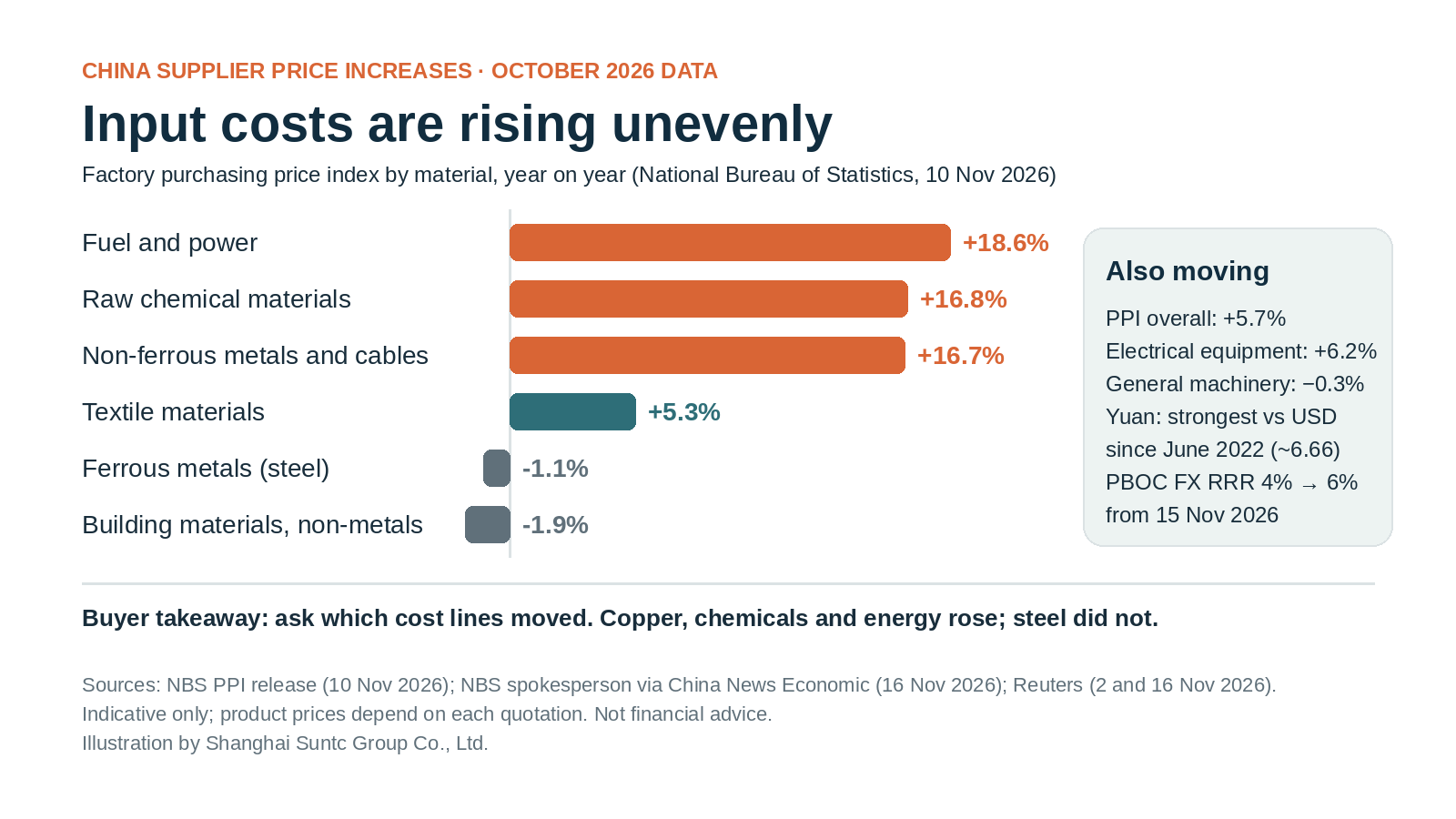
This is the most useful part of the NBS release for buyers, because it breaks factory input prices down by material:
| Input category (purchasing price index) | October 2026, year on year | Month on month |
|---|---|---|
| Fuel and power | +18.6% | +4.1% |
| Raw chemical materials | +16.8% | +3.2% |
| Non-ferrous metals and cables | +16.7% | −0.3% |
| Textile materials | +5.3% | +0.6% |
| Ferrous metals | −1.1% | −0.6% |
| Building materials and non-metals | −1.9% | +0.4% |
On the selling side, the same release shows producer prices for general-purpose machinery at −0.3% year on year, metal products at +1.7%, rubber and plastic products at +2.9% and non-ferrous smelting at +18.6%. The NBS spokesperson added that electrical machinery and equipment prices rose 6.2% year on year.
In short: a quote dominated by steel structure is not facing the same cost pressure as one dominated by copper windings, cables, plastics or energy-intensive processing.
Are all Chinese export prices rising?
No. China’s exports rose 35.2% year on year in October 2026 (Reuters, 10 November 2026), and Caixin (10 November 2026) noted that much of the growth came from higher prices rather than volumes. But a Global Trade Alert briefing (22 October 2026) found the price rise highly concentrated: Chinese manufactured export prices rose 9.4% over the 12 months to September 2026, yet without the top 10 contributing products the average rose only 1.6%, and consumer goods prices were still falling.
So a headline about “rising Chinese prices” is not, by itself, a reason to accept a rise on every product line.
Which equipment orders are most exposed?
The table below maps the NBS categories to typical cost drivers. It is a starting point for questions, not a forecast for any product.
| Order type | Cost lines to look at | What to ask the supplier |
|---|---|---|
| Generators, motors, control panels, cables (e.g. hydropower equipment) | Copper and cable (non-ferrous +16.7%), electrical equipment (+6.2%) | Copper weight per unit and the price basis used in the old and new quote |
| Wheeled excavators, material handlers, tractors | Steel (ferrous −1.1%) vs hydraulics, hoses, tyres, paint, electrics | Which components changed in price, with supplier evidence |
| Spare parts with rubber, plastic or coatings | Chemicals (+16.8%), rubber and plastic products (+2.9%) | Whether the rise applies to all parts or only to specific items |
| Energy-intensive processing (casting, heat treatment) | Fuel and power (+18.6%) | Whether a surcharge is temporary and when it will be reviewed |
How should buyers respond to a China supplier price increase?
Use this checklist before accepting a revised price:
- Ask for the cost split. Request the share of the price driven by steel, copper, components, labour and currency. A supplier with real cost pressure can usually show it.
- Check the currency basis. Ask what exchange rate the old quote assumed. If the quote is in US dollars, the supplier’s RMB income per dollar falls as the yuan strengthens.
- Separate materials from margin. Accept index-linked changes only on the lines they affect, not on the whole order.
- Agree validity and adjustment rules in writing. Set a clear quote validity date, the reference index or rate, and a threshold before any adjustment applies.
- Time the deposit. A price is normally fixed only when the contract is signed and the deposit paid. Plan this before the factory holiday season (see our Chinese New Year 2027 order timeline).
- Compare like with like. Use a structured comparison so specification changes are not hidden inside a price change (see how to compare equipment quotations).
A hypothetical example
A distributor receives a 6% increase notice on a mixed order of small generators and wheeled-excavator spare parts. Instead of accepting it across the board, the buyer asks for a cost split. The supplier shows higher copper and cable costs on the generators, but cannot point to a material increase on steel wear parts. The two sides agree a revised price on the generator lines only, with an adjustment clause tied to a stated copper reference and a 30-day validity. This example is illustrative and does not describe a real customer or transaction.
SUNTC view: question the breakdown, not the headline
Price pressure in China is real in some materials and absent in others. The buyers who do best will be those who ask suppliers to show which lines moved, agree how future changes will be measured, and lock terms before the year-end and holiday rush.
Shanghai Suntc Group Co., Ltd. is an international trade and export company in Shanghai Free Trade Zone, not a manufacturer. We can discuss hydropower equipment, wheeled excavators, material handlers and agricultural machinery, together with quotation reviews and export coordination. Manufacturer, configuration, pricing basis and contracting responsibilities are confirmed in each specific quotation. Contact Jack Chen at info@suntc.com or WhatsApp +86 150 0214 3331, visit our contact page, or send your quotation details below.
Buyer questions
Why are Chinese suppliers raising prices in late 2026?
Official data shows higher factory input costs, led by fuel and power, raw chemical materials and non-ferrous metals, while the yuan has strengthened about 5% against the US dollar this year. Both reduce margins on fixed US-dollar quotes, but the effect differs by product.
Is steel making Chinese machinery more expensive?
Not according to October 2026 NBS data: the ferrous-metals input price index was down 1.1% year on year and general-purpose machinery prices were down 0.3%. Copper-heavy electrical items, hydraulics, rubber, plastics and energy-intensive processing are more likely sources of cost pressure.
Should I accept a blanket price increase from a Chinese supplier?
Ask for a cost split first. Accept changes only on the lines that real cost movements affect, and put the reference index, threshold and quote validity in writing.
Does a stronger yuan make my US-dollar quote more expensive?
Not automatically, but it squeezes the supplier’s margin because each dollar converts into fewer yuan. That is why suppliers may shorten quote validity or ask for a currency adjustment clause, so agree the exchange-rate basis when you sign.